
Have you hit a plateau in your business and are looking to grow? Guide your marketing strategy by using this simple yet powerful tool. Developed by H. Igor Ansoff in 1957, this matrix can help you determine how to grow based on what you are or are planning to do. Using this tool will compel you to consider the relationship between your product and consumer, resulting in 4 possible growth strategies.
First consider, are you looking to expand business with your present customers or new customers? Next, are you looking to offer the same product/service or a new product or service.
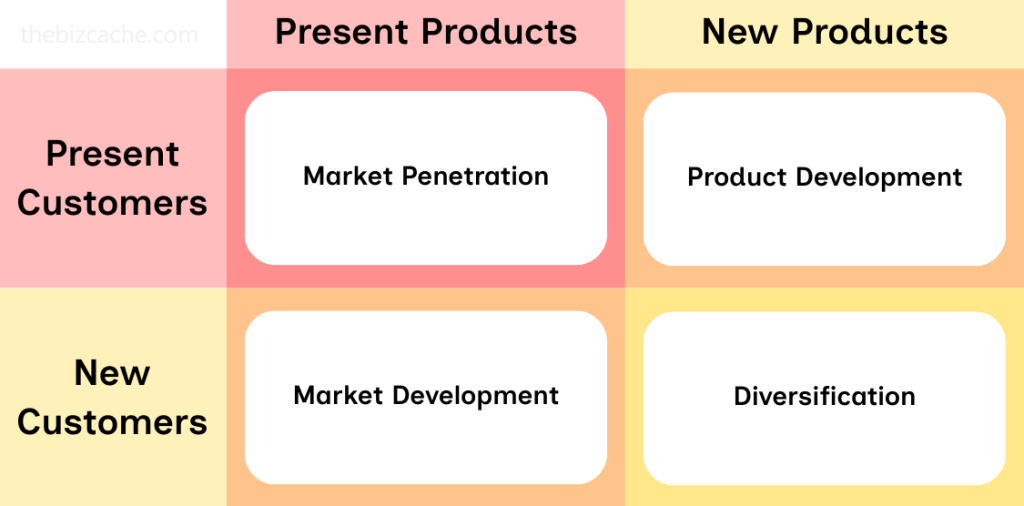
Here we find our driving growth strategy and we can dig into some activities that should support our goals. Lets dive deeper into each strategy and get some ideas of how we can implement these within our business.
Market Penetration
You are looking to get more from your existing customers. These customers trust you and they consist of your existing audience. When you think of your existing customers, you probably think of these qualities: loyal, trusting, familiar, satisfied, engaged, connected, and underserved. Your customers love your product/service. When you consider your market, it’s not fully saturated. If these statements are ringing true then let’s move into some actionable steps…
- Sell more to existing customers via upsells and value add propositions
- Create a loyalty program
- Create a consistent communication channel like newsletters
- Offer discounts or deals to existing customers
- Increase availability in additional locations
- Participate in low cost brand visibility such as social media and collaborations
- Give referral incentives to existing customers
- Use testimonials to promote your product and build loyalty
- Consider your niche and master it
Market Development
You have a great product, but you need more customers! You want to get a wider audience without spending wads of cash. When you analyze your business’ strengths you think: scalable, untapped, repeatable, plateaued, local (unknown), or efficient. Here’s what you might want to add to your business plan…
- Collaborate with a partner business in a different geographical location or market
- Target a new customer segment (age, profession, etc.)
- Offer shipping
- Change the method for selling- ex. consider B2B instead of only B2C
- Consider a new niche
- Test marketing without dropping big $$$$ with limited time ads or offers
Product Development
If you can offer your customers more, they will buy! It has to be the right product but you don’t want to spend too much money (or too much of your time) on creating a whole new venture. These descriptors might resonate with you: expandable, pressure, asking, popular, underutilized, capped, trusted, repurposed. Now let’s look at some actions you can take in product development.
- Create a tier or bundle your existing services or product to capture value
- Bundle ideas: seasonal, starters, popular
- Upgrade or improve your existing product
- Consider add-ons like service plans, support, or refills
- Ask yourself how to solve your customer’s next problem
- Test your market before you fully develop your new product
- Use feedback and be sensitive to repeated questions, requests, and complaints
- Turn your service into a product, or your product into a service
Diversification
Diversification can be the adventurous strategy of the 4 discussed here. We are going to focus on small yet smart activities that are achievable for small businesses. While this strategy means a new market and a new product, you must still use your existing skills, knowledge, and assets to make smart, complimentary moves. Some words that may feel right if you are considering this strategy are: saturated, outgrown, profitable, efficient, mature, curious, requested, ambition, capable. Let’s dive into some actionable tasks.
- Find industries where you can leverage your existing skillset
- Launch a new product line
- Go digital (or physical, or retail)
- Try a new market such as B2B or B2C
- Sell your unique knowledge by coaching, speaking, writing, or teaching
- Acquire a complementary business or business partnership
- Do you have a physical space? Use it in a different way to make money.
- Is your business seasonal? Consider an opposite seasonal business.
- Create a new brand for a separate idea







Leave a Reply