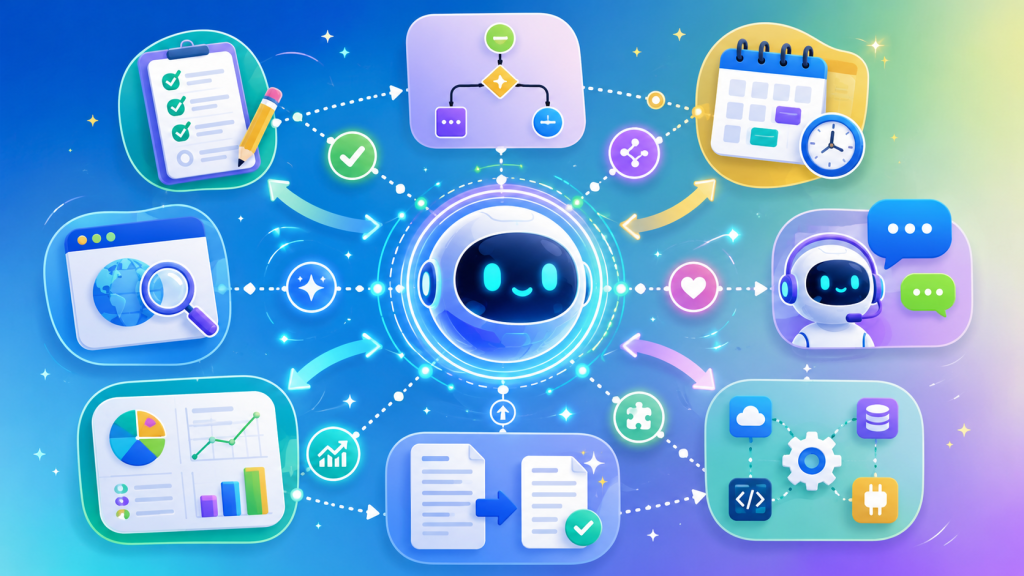
Companies everywhere are using AI to augment tasks, improving the efficiency and productivity of their teams. The models are becoming more capable, having the ability to do more than just write code or language. In the agentic AI era, we see automation of procedural tasks, allowing humans to focus on creativity, communication, judgement, and other higher value activities. Smart organizations ensure there’s a human in the loop. They know what AI can and can’t do. So let’s dive in so we can understand that too.
What is Agentic AI
Unlike a chatbot, Agentic AI can carry out tasks from start to finish. An AI Agent can access information, use tools like email or CRM, and make decisions based on the inputs. Let’s review some real world examples of AI Agents…
- Supply Chain: Dow (Chemical) built an AI Agent in Microsoft Copilot Studio to help with supply-chain related tasks. The agent reads invoices from emails and compares them with expected charges to identify billing errors and route these for correction. This helps with accuracy without manual employee review.
- Scheduling: Vivint uses an AI Agent to schedule, reschedule, or cancel technician’s appointments. This use of agentic AI reduces the amount of time employees spend managing routine scheduling requests and provides customers with faster service.
- Customer Support: Salesforce uses Agentic AI to answer questions and handle employee HR & IT requests, submitting tickets and resolving some queries on it’s own. Employees get help faster and HR/IT support teams have a reduced workload.
- Clinical Documentation: Intermountain Health uses Microsoft Dragon Copilot to listen to patient visits, creating clinical notes, and updating medical records within Epic. This allows clinicians to spend more time on patient care than chart updates.
Understanding AI in the Agentic Era
First let’s discuss some terms that you will need to understand in order to dive into the AI Agent Ecosystem.
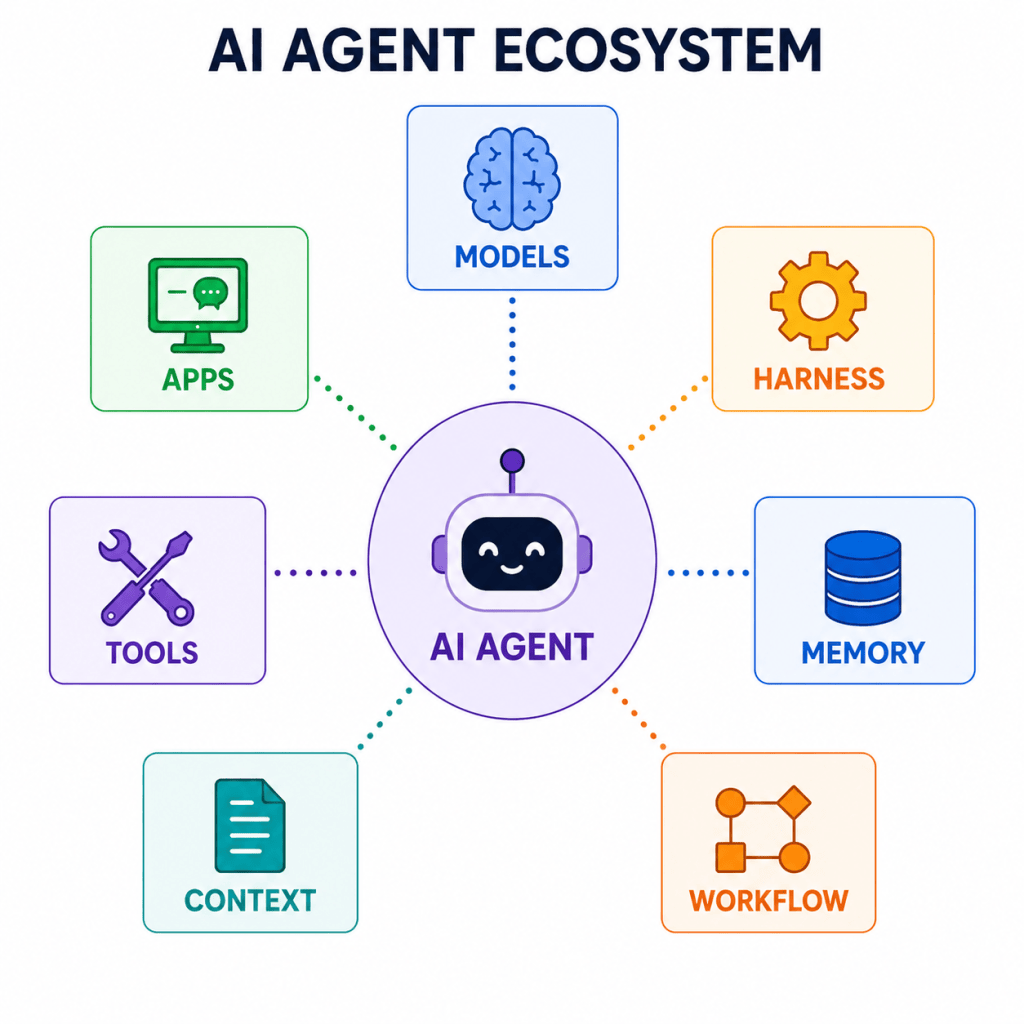
- Models: Models are the “brains”. This is the actual LLM. Ex. GPT 5.5, Grok 4, Claude 4
- Apps: The app is the product you use to interact with the model such as chatgpt.com or gemini.google.com.
- Harness: The harness is a framework that manages the LLM. It orchestrates how it behaves by enforcing rules and workflows. The harness controls how the model accesses data sources, tools and other external systems.
- Tools: Tools are the calculators, databases, web searches, email, CRM systems, API’s, or other external resources the AI has access to.
- Memory: How much information the AI will retain over time and across interactions.
- Context: The information which the AI will use to respond to the current task. This could include data retrieved using tools, data in the memory, instructions, and any relevant information it has access to.
- Agents: An AI Agent utilises everything above to perform tasks autonomously or semi-autonomously.
- Workflow: Steps are completed by AI or a mix of AI and human-in-the-loop steps to complete a task from start to finish.
Best Use Cases for Agentic AI
- Repetitive, multi-step tasks with clear rules
- Multiple systems are used for one task
- Situations where quick action is valuable
- High volume tasks
- Processes with defined human checkpoints
Poor Use Cases for Agentic AI
- High risk decisions that require human judgement
- Situations with unclear or changing rules
- Edge cases, unique tasks
- When data is low quality or incomplete
- Tasks with little to no human oversight





 The Biz Cache
Leave a comment